
WHAT ARE THE BEST TRAINING SPLITS FOR SIZE AND STRENGTH
Updated: Sep 21
I don't know if you could tell, but I absolutely love to research training science and share everything I learn through writing. And I was particularly interested in this topic and have been for quite some time. I was reluctant to write the piece until I had enough real world evidence from training clients over the years and research, so that I could make a solid case for reliable recommendations. Splits represent individual and collective training frequencies of muscle groups and movement patterns. They are the foundation or base of all programming features and dictate the rest of your variables. There are quite a few formats floating around so it can become difficult to truly discern what works the best for someone, especially based on their lifting experience and skill. Since you can't accurately and systemically predict a timeframe for someone's training level imo, it's best just to start at the beginning and then provide standardized training split progressions that seem to generally coincide with each person's experience and abilities.
Beginner Training Splits:
Before I provide you with a failproof training split for anyone new to strength training, or struggling to make progress for the first time, please consider the recovery chart guidelines below compliments of muscletechnics.com. 1
The scientific recovery times
Muscle Group | Recovery Time | Fiber Type | Train Again |
Abs | ~30 hours | Predominantly slow-twitch | Every other day |
Arms (Biceps/Triceps) | ~48 hours | Mixed | Every 2 days |
Chest | ~56 hours | Predominantly fast-twitch | Every 2–3 days |
Shoulders | ~56 hours | Mixed | Every 2–3 days |
Legs (Quads/Hamstrings) | ~60 hours | Fast-twitch dominant | Every 2.5 days |
Back (Lats/Traps) | ~60 hours | Large muscle mass | Every 2.5 days |
The table above is easily the best reference I've seen to explain the essential training concept. Outside of training volume (sets x reps x load), specific muscular recovery guidelines are going to be your biggest influencer for undoubtedly hypertrophy or growth, and to a large degree strength development. However, at a certain point when someone is in limbo between an intermediate and advanced lifter neural recovery is going to reign supreme and most likely take longer than muscle recovery, thus voiding the chart above. Mind you this information pertains to such a small number of people you shouldn't worry.
The Ferruggia Total Body Approach

15 lbs. of muscle in 8-12 weeks

25 lbs. in 12 weeks
RBS Sample 3-Day Training Template:
Day #1:
A1. Traditional Deadlift
A2. Seated Cable Row
A3. Weighted Pushup
B1. Core Stability or Mobility
B2. Calf Raise Variation
Day #2:
A1. Chin-up or Neutral Grip Chin-up
A2. Heavy Reverse Split Squat
A3. Incline Press
B1. Standing Bilateral DB Bicep Curls
B2. Cable Pushdowns
Day #3:
A1. Back Squat
A2. T-Bar Rows
A3. Bench Press
B1. Barbell Shrugs
B2. Seated Hang Cleans
B2. Farmer Carry Variation
Note: You can add in another exercise for a highly deficient area especially if you are a newbie (i.e. Bent knee or straight knee hip dominant exercise)
Total body splits are king when it comes to beginner-intermediate levels lifters. We've used with great success for years and most of it is adopted from Jason Ferruggia. He was the first trainer to my understanding that advocated total body splits for growth and utilized them with the masses. You can find his muscle building book here from the RBS Resources section. I always strive and pride myself on giving credit it where it is due. I was a natural hard-gainer who amassed 60 lbs. of raw muscle over the course of years on my fitness journey, and a large part of my success was because of Jason's research and methods. Often times coaches don't realize it but they are just using someone else's approach unknowingly by default. The split definitely complies with the recovery chart above and flirts the line on overtraining sooner rather than later since you are training fast twitch dominant and or large muscle groups up to 3x per week (i.e. Legs, Back, and Chest). This is the upper limit unless you are using steroids, but even then you are entering a "point of diminishing returns," according to StrongerbyScience. They did extensive research on training splits and actually found that training a muscle group more than 2x per week can get you into trouble. The only potential exception I've seen is with genetically favorable, raw beginners. Other than that 2x per week is going to be your "sweet spot" for training each muscle group/movement pattern and the splits I'm about to share with you reflect that scientific discovery.
Intermediate Training Splits:
This is the split that works well for most experienced lifters, high school upperclassmen, and collegiate level athletes. These two industry popular splits are the most common since they balance recovery and frequency better than the total body approach slightly. The only issue is that it requires more motivation and dedication with that extra fourth day. There is a 3-day approach too, but it's not going to be optimal for hypertrophy development in intermediate level lifters or athletes in my nearly 20 years of experience. (30 if you include the fact I started lifting competitively at the age of 12).
THE RBS MODIFIED 3 DAY SPLIT
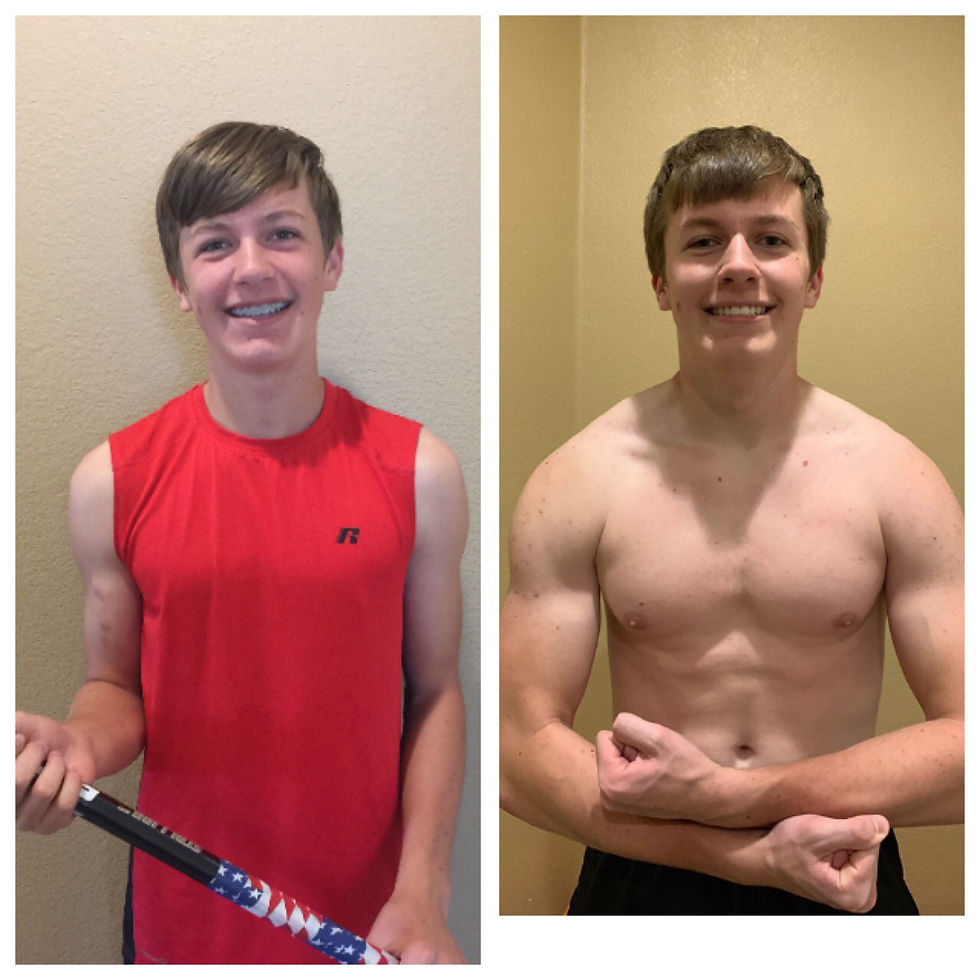
30 lbs. in 6 months!

20 lbs. in 4 months

25 lbs. in 6 months

20 lbs. in 4 months
To learn more about "The RBS Get Jacked" Program click here
RBS Sample 3-Day Training Template:
Day #1: (ME Lower)
A1. Hex Bar Deadlift
B1. RFESS
B2. Barbell Hip Thrusts
C1. Core Stability or Mobility
C2. Calf Raise Variation
Day #2: (ME Upper)
A1. Bench Press
B1. Chin-ups
B2. Barbell Military Press or Scrape the Rack Press
C1. Standing Bilateral DB Bicep Curls
C2. Cable Pushdowns
Day #3: (DE-RE Lower/Upper)
A1. Hex Bar Jump Squat
A2. Banded Speed Press
B1.. Heavy DB Rows
B2. DB Press
C1. Hercules Hold (Trap + Forearm)
C2. Pronated Seated High Cable Rows
OR.....
4 Day Lower-Upper Training Template:
Day #1: (ME Lower)
A1. Hex Bar Deadlift
B1.. RFESS
B2.. Barbell Hip Thrusts
C1. Hack Squats
C2.. RDL's
D1. Core Stability or Mobility
D2. Calf Raise Variation
Day #2: (ME Upper)
A1. Bench Press
B1. Chin-ups
B2. Barbell Military Press or Scrape the Rack Press
C1. Weighted Pushups
C2. DB Rows
B1. Standing Bilateral DB Bicep Curls
B2. Cable Pushdowns
Day #3: (DE-RE Lower)
A1. Hex Bar Jump Squat
B1. Heavy Backward Sled Tow
B2. SLDL (2 DBs)
C1. Front Squats
C2. Heavy Glute Bridges
D1. Core Stability or Mobility
D2. Seated Calf Raises
Day #3: (DE-RE Upper)
A1. Banded Speed Press
B1. inverted Rows
B2. DB Press
C1. Incline Press
C2. Neck Supported Bent Over DB Rows
D1. Hercules Hold (Trap + Forearm)
D2. Pronated Seated high Cable Rows
Alright now I may sound like a complete hipocrite, since I told you that four days of lifting was ideal for hypertrophy and muscle building training, and here I am showcasing results of athletes who followed a 3 day per week template long-term. There is a simple recovery based reason for this though, and that is that these individuals and the rest that you witness in our testimonial crop were pretty heavily involved in off-season sporting practices and training at the same time they were lifting and athletic training.
Moreover, you have to consider the undeniable reality that they also needed to increase their speed, power, agility, and strength to the highest degree possible. With that being said, a big limiting factor in this classic case is going to be "neural freshness" to actually allow peaking or supercompensation to occur throughout the body. This concept is critical during off-season phases to foster several specific speed adaptations. Trust me I've tried to implement 4 day routines in athletes for years, but to no avail, with the exception being dedicated pre-season conditioning phases where the specific focus or blocks of performance measures listed above are already completed and satisfied. On the other hand, we have had clients come in with just pure aesthetic aspirations looking to get bigger, without the competing demands of athletics who weren't too old and 4 day routines were very successfully administered.
ADVANCED TRAINING SPLITS:
And of course last on the list is for the elite. Unfortunately, I'm only going to attempt to provide you with some simple advice and things to think about in this department. I'll never claim to be someone that I'm not on this platform, and a bodybuilding coach I am not. I know quite a bit about bodybuilding and healthy clean eating and nutrition since I've written two books endorsed by some of the best in the business, but I've never practiced advanced bodybuilding programs or techniques with true professionals that require the best coaching, understanding, and real world experience and have lived the sport themselves. Since we are talking about training splits exclusively, you can easily identify various 3-6 day training splits that are valid online through AI these days. I'd be lying if I told you otherwise, and that is a great start. Lastly, the beginner and intermediate programs are definitely sufficient enough for 90 percent of the public looking to get as big as possible. I've never seen someone overtrain and quit getting appreciable results with the previous splits.
The real only thing I want to say on this front is the culturally hated "Body-part Split" becomes much more appropriate at this stage in the muscle building game. For some reason it is very counterintuitive in lifting culture, as is many things. You see beginners electing this approach, when it should be reserved for those who have paid the price and have earned this style of training and can actually benefit from it maximally. Primary reason being that the training volumes will be the highest at the point in development, and recovery intervals are going to be much higher as a result (i.e. 72-96 hours +). Its really that simple. There is a lot of debate about conflicting research regarding isolated focused drills vs. compound ones on growth levels and comparative muscle activation levels at this point, and they all work for any level of lifter. But the amount of strength and volume bodybuilders and extremely muscular individuals alike can achieve is what ultimately dictates more recovery time and days, not necessarily exercise selection. They are still doing the same exercises they were previously for the most part, just at higher volumes and intensity to continue practicing Progressive Overload. comparative muscle activation levels at this point,
Last but not least, because of less time constraints with a higher number of training days, and more of an individual body part or muscle group focus in advanced splits, "touch up" type work satisfied with some isolation exercises (i.e. arms, raises, extensions, curls, pushdowns, shrugs, flyes, pullovers, thrusts, and bridges) becomes more appropriate along with obvious continuation of high quality compound movement selections to complement the lifter.
SCIENTIFIC REFERENCES:


Comments